EB-Navigation · 300 episodesText-only decision model
GeoLingo
Translating geometry into language for embodied navigation
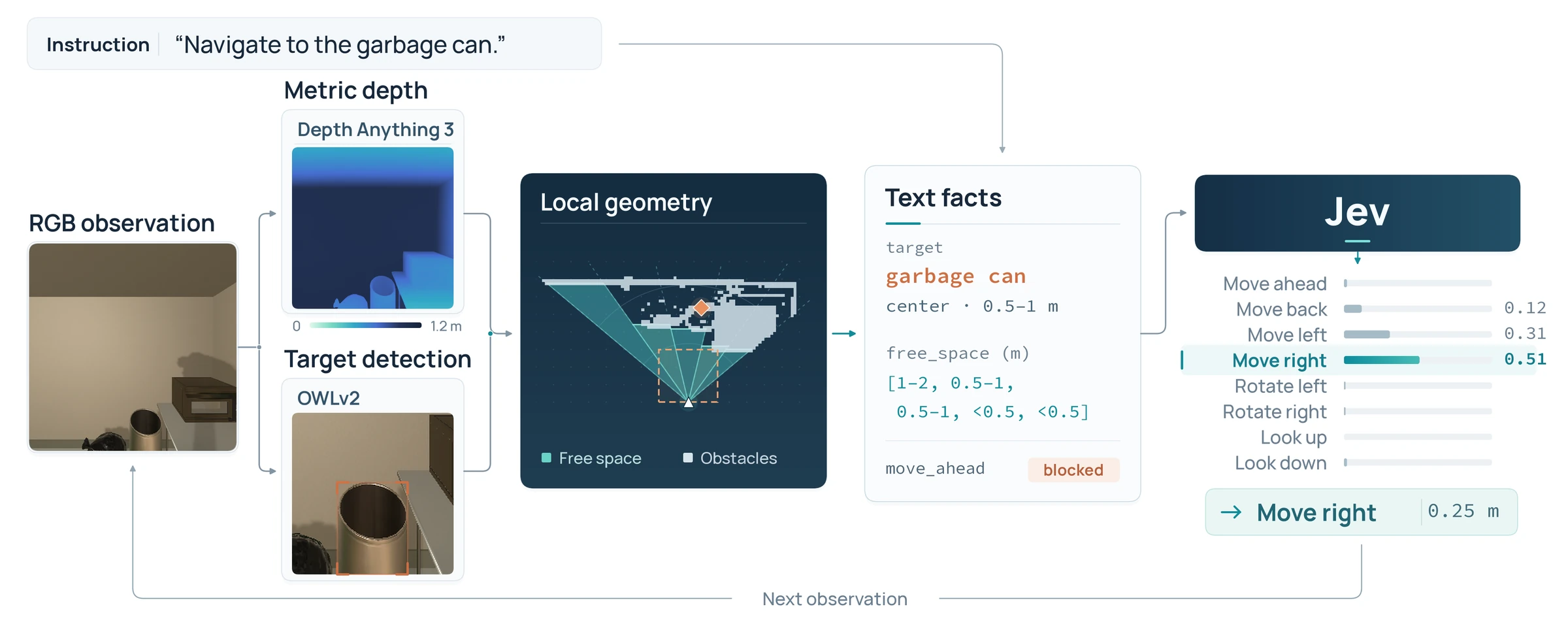
The decision model never sees a pixel. Every frame becomes metric depth and a target box, the geometry becomes a few lines of text in metres, and Jev picks the next move from that text alone. It succeeds in 46.7% of all 300 EB-Navigation episodes.
A recorded episode, as Jev sees it
Camera metric depth
Text facts Jev reads
Jev's answer
Highlights
Method
From a frame to a paragraph
Each step runs through three stages, and each stage is one sub-package of the code. Perception measures the room in metres, the language layer writes the measurements down, and Jev, a decision model that answers typed questions with probabilities, picks one of eight actions.
-
1Perceive
perception/Depth Anything 3 turns the 500 × 500 frame into metric depth and OWLv2 finds the target. The depth is back-projected, levelled against the floor and cut into five sectors.
DA3 · 0.15 sOWLv2 · 0.22 s
-
2Describe
language/Free space per sector, a collision check for the next 0.25 m step, the target's sector and distance, and the last three actions, written in four distance bins.
under 0.5 m0.5 to 1 m1 to 2 mover 2 m
-
3Act
decision/Jev answers typed questions with probabilities: the target's object type once per episode, where the target is while it is out of view, and the next of eight actions.
Jev · 0.34 s8 actions
Camera
Hover the frame to read DA3's metric depth at that point.
Top-down: what the five sectors measure
obstacle visible floor next 0.25 m step
Facts: exactly what Jev read
Jev's answer
Examples
Six runs, replayed step by step
The frame the robot saw, the depth DA3 measured, the box OWLv2 found, the facts Jev read and the action it chose, all recorded during the full evaluation. The top-down path is rebuilt from the actions and matches the simulator's distance to the target at every step. Runs play on their own, and clicking an action shows that step.
Actions
Results
All 300 episodes at a glance
EB-Navigation asks for the same 60 scenes and targets in five instruction styles, so each column below is one scene and target, and each square is one episode. Twelve scenes are solved under all five instructions and 22 under none: the scene decides more than the wording.
Show as a table
Latency
Fast enough for a robot
Mean server time per step on one H100. The three models run one after the other, and Jev's answer is a network request. Three runs sharing one GPU still finish a step in about a second.
Show as a table
Limits
Where it fails
160 episodes end without reaching the target. The largest group starts in perception: the target is rarely detected, or another object is taken for it.
- Detection. The largest group includes 17
visual_appearanceepisodes where Jev picked the wrong object type from a description of looks. Adding “trash can” and “bin” as detector queries took GarbageCan from 0/5 to 5/5 on a development sample. - Action constraints. Writing a constraint into the action option itself (“NOT USEFUL NOW: the camera already looks 30 degrees down”) stopped repeated
look_downbetter than a general rule. - Scene difficulty. Across the five instruction styles, the same 12 scenes always succeed and the same 22 always fail.
long_horizonalso turns the start pose by 180°.